The Pareto Principle and Church Giving
Why a century-old idea still explains how giving, volunteering, and ministry impact are distributed inside American churches.
The ChurchStacks Team
March 22, 2026 · 8 min read
In this article
There is a pattern that shows up almost everywhere people gather, work, buy, donate, and build. A small share of the whole usually carries a surprisingly large share of the result.
In business, it often means a handful of products drive most revenue. In software, a small number of bugs cause most user pain. In churches, it can mean a modest slice of households accounts for most giving, most volunteer hours, or most ministry leadership.
That pattern is called the Pareto Principle, better known as the 80/20 rule. It is not a law of nature, and the numbers are rarely exactly 80 and 20. But the basic idea is stubbornly durable: a few inputs tend to drive a disproportionate share of outcomes.
For churches, that is not just an interesting bit of economics. It is a pastoral and operational reality. If you understand where giving is concentrated, where volunteer energy is concentrated, and where ministry impact is concentrated, you can lead with more clarity, less guesswork, and a healthier sense of stewardship.
Where the idea came from
The principle is named for Vilfredo Pareto, the Italian economist and sociologist who observed, in the late 19th and early 20th centuries, that wealth in Italy was distributed unevenly. In the popular retelling, about 80 percent of the land was owned by 20 percent of the people. Pareto was studying wealth and power, not productivity hacks.
The idea became broadly useful in management because Joseph Juran, one of the giants of 20th-century quality control, saw that the same imbalance appeared in manufacturing and organizational life. Juran turned Pareto's observation into a practical tool. He called it the work of identifying the "vital few" among the "useful many."
That shift mattered. Pareto noticed the pattern. Juran taught leaders how to use it.
Why it keeps showing up
The Pareto Principle survives because organizations are not flat. They never have been.
In any church, some households are more engaged than others. Some volunteers are more available than others. Some ministries are better staffed, better led, or better funded than others. Over time, the effect compounds.
The point of Pareto analysis is not to glorify the top 20 percent. It is to reveal the structure of reality. Once you see the structure, you can respond wisely.
How major companies use it
The principle has endured because serious companies have found it useful in the real world, not because it looks clever on a keynote slide.
Illinois Tool Works, the Fortune 200 manufacturing company, has built an entire operating discipline around 80/20. ITW describes its "80/20 Front-to-Back Process" as part of its business model, using it to focus on the highest-value customers, products, and workflow improvements. In plain English, the company is constantly asking a hard question: which few things matter most, and what should we stop overcomplicating?
Microsoft has used the logic in retail and inventory analysis — noting that in retail it is common for about 20 percent of SKUs to account for roughly 80 percent of sales. Companies that spread themselves evenly across everything often end up overinvesting in what matters least.
McKinsey has pointed to the same pattern in industries as different as semiconductors, oil, and analytics. Once you can identify the vital few, you stop wasting time treating every asset as equally important.
None of those examples are about churches. But all of them make the same point. Leadership gets sharper when it stops pretending every variable matters equally.
What this looks like in a church
Churches do not use the Pareto Principle to maximize shareholder value. They use it, or should, to practice better stewardship. In a church context, Pareto analysis is useful in at least five places.
1. Giving concentration
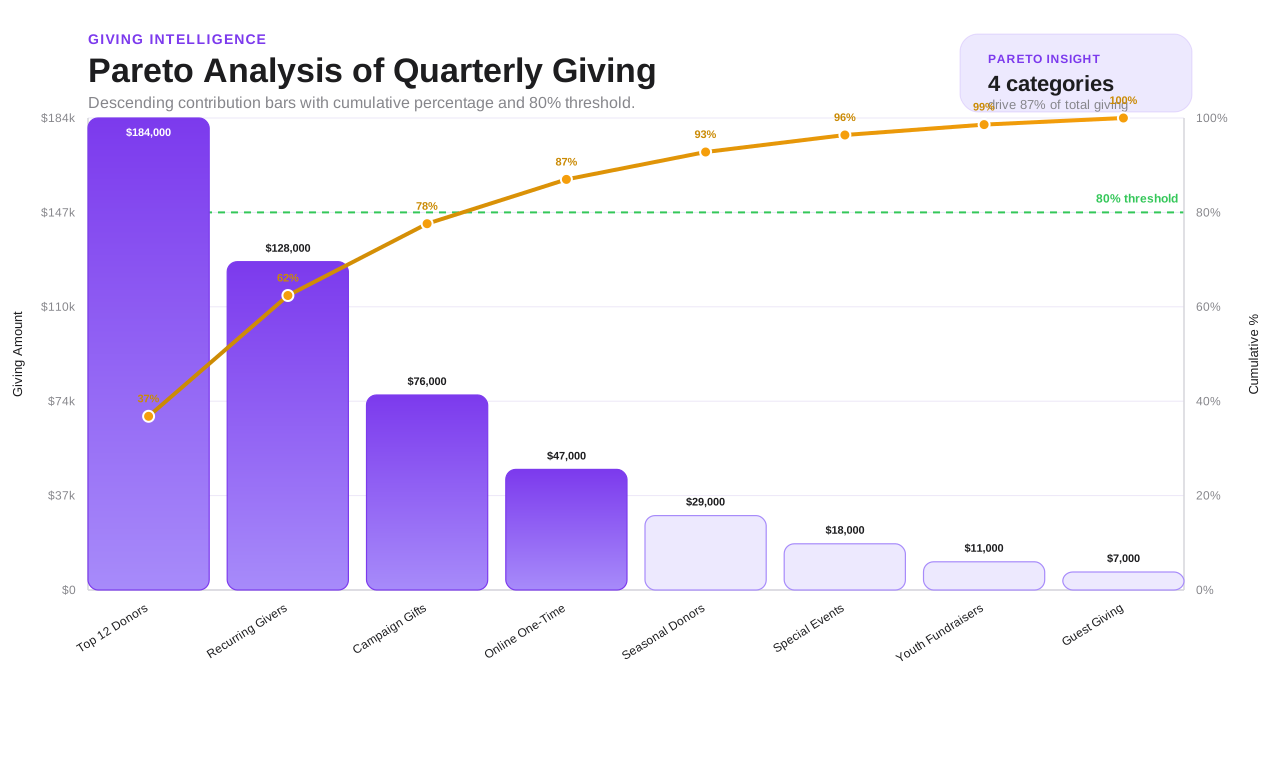
This is the most obvious use case, and often the most sensitive. Many churches discover that a relatively small group of households contributes a large share of total giving. That does not mean the church is doing anything wrong. It does mean the church should understand its financial concentration risk.
If 15 or 20 percent of giving households fund the majority of the budget, the church is more exposed than it may realize. A few relocations, retirements, job losses, or quiet disengagements can create real strain. The right response is not panic. It is visibility.
- What share of annual giving comes from the top 10 percent of donors
- How much of the budget depends on recurring givers
- Whether campaign giving is masking softness in regular giving
- Whether the church is broadening participation or leaning harder on the same few families every year
2. Volunteer concentration
Most churches have a version of this problem, even if they do not name it. The same small group serves in children's ministry, greets on Sundays, joins setup teams, leads groups, and says yes when nobody else does. They are faithful. They are generous. They are also at risk of burnout. Pareto analysis can help a church spot the imbalance before the people carrying the ministry quietly disappear.
3. Ministry impact
Not every program, class, event, or communication channel creates the same fruit. A church may discover that a few ministries produce most first-time guest follow-up, most volunteer development, or most local outreach impact. That does not mean cut the rest — it means leaders should know which ministries are carrying unusual weight.
4. Pastoral care and retention
A small number of signals often explain a large share of disengagement risk: a drop in attendance, a stop in giving, a missed serving rhythm, unanswered messages, or a break from small-group life. If you can identify the few signals that best predict drift, you can intervene earlier and more personally. That is one reason the principle fits church software so well.
5. Budget and staffing decisions
Churches frequently budget as if every ministry lane deserves the same level of attention. Pareto analysis gives leadership teams a clearer picture of what is truly carrying the mission — which ministries produce the clearest outcomes, which donor segments are most stable, which communication channels actually move people.
Why churches should use it
Because stewardship is not only about spending less. It is about seeing clearly.
The Pareto Principle helps leaders do three things well. First, it helps them name concentration honestly — hidden concentration is where preventable fragility begins. Second, it helps them allocate care more wisely — pastors should not have to hunt for drift signals in a spreadsheet. Third, it helps them widen participation. The goal is not to squeeze more from the faithful few. The goal is to invite more people into generosity, service, and belonging.
Used well, Pareto analysis does not make a church more corporate. It can make a church more attentive.
Which churches use it
Very few churches publicly publish a donor concentration chart. For obvious reasons, many treat that kind of internal stewardship data as private.
What we can say with confidence is that the pattern is widely recognized in church giving circles. Pushpay, one of the best-known church giving platforms, has written directly about the "80/20 rule" in church generosity and argues that many churches are too dependent on a small number of giving families. In other words, the principle is already in use in the church software and stewardship world, even when local churches are not naming it from the pulpit.
The better question may not be "Which churches use it?" but "Which churches are wise enough to measure what they are already living?"
The point of Pareto analysis:
"The Pareto Principle does not tell a church whom to love most. It tells a church where to look first. And in ministry, that can make all the difference."
— The ChurchStacks Team
What churches should use it for
Not for ranking members by importance. Not for building ministry around the biggest givers. Churches should use the Pareto Principle for diagnosis, not favoritism — most helpfully to:
- Understand donor concentration risk
- Identify participation gaps in giving
- Spot volunteer overload before burnout
- Surface ministries producing outsized fruit
- Find early warning signs of disengagement
- Guide board-level conversations about resilience, not just growth
Sources
- Juran Institute, "Pareto Principle (80/20 Rule) & Pareto Analysis Guide"
- Illinois Tool Works, "ITW Business Model"
- Microsoft Industry Blog, "Overrule the Pareto Principle"
- Pushpay, "Beat the 80/20 Rule and Level Up Giving at Your Church"
See ChurchStacks Pareto Intelligence in action.
Free plan up to 40 members. No credit card required.